

Hype Words Are Killing Your Technical Content
Why Engineers Trust What Doesn't Try to Impress Them

Every time you write “game-changing,” an engineer closes your tab.
“Revolutionary” triggers their BS detector. “Groundbreaking” sounds like a marketer who’s never shipped code. “Seamless integration” is code for "budget three sprints and a nervous breakdown."
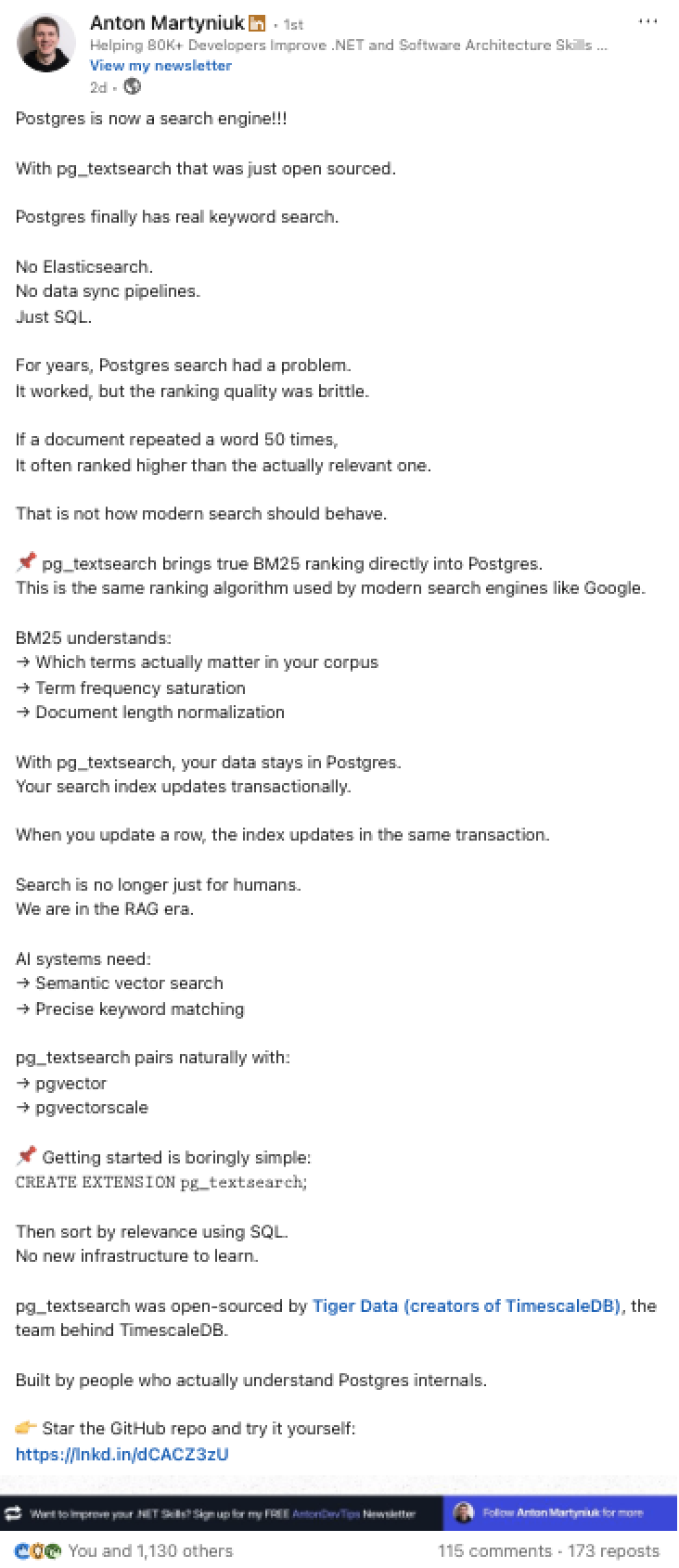
Meanwhile, a sponsored post about Postgres search extensions just hit 1,131 likes and 173 reposts.
The hook? Six words that sound like an insult:
“Getting started is boringly simple.”
Not impressive. Not exciting. Boring.
And that’s exactly why it worked.
I call it the “Boring Simple” framework, and it’s the fastest way to build trust with engineers who’ve been burned by marketing language their entire careers.
🎁 Here’s What You’ll Get Today (free)
The 3 psychological triggers that make anti-hype language convert
The 9-part anatomy of the perfect “Boring Simple” post
The 9-step process to build yours in 15 minutes
3 advanced variations for different contexts
The 4 classic mistakes that make you sound incompetent instead of confident
💎 Paid Subscribers Also Get
The fill-in-the-blank “Boring Simple” prompt that does the 9 steps for you
🔪 The Brutal TL;DR
The Mistake: Using hype words that trigger technical audiences’ BS detectors
The Play: Undersell the excitement, oversell the simplicity
The Psychology: Engineers trust what doesn’t try to impress them
The Result: Higher engagement from the audience most resistant to marketing
🧠 The Psychology of Boring
Trigger 1: Hype triggers skepticism
Technical professionals have been lied to by marketing copy for decades. “Seamless integration” that took 6 months. “Intuitive interfaces” that required 40-page docs. “Enterprise-ready” solutions that crashed in production.
This creates a reflex: the more something sounds impressive, the less they believe it.
“Boring” disarms this reflex. Nobody lies by calling their product boring. The word itself is a credibility signal: you’re confident enough to undersell.
Plus, ‘boring’ is how engineers actually talk to each other. ‘How was the migration?’ ‘Boring. Worked first try.’ That’s the highest compliment in technical culture. The word signals: written by one of us, not by marketing.
Trigger 2: Underselling signals confidence
Here’s the counterintuitive part: when you undersell, audiences assume you’re more competent, not less.
Why? Because only someone who deeply understands the value can afford to be casual about it. Hype signals insecurity. Understatement signals maturity.
When Anton writes “boringly simple,” readers assume the tool must be genuinely good. Only someone confident in the value would risk underselling it.
Trigger 3: Boring means no surprises
“Boringly simple” isn’t just about trust. It triggers physical relief.
Technical readers carry anxiety about every new tool: How long will this take to learn? What will break? How many weekends will I lose?
“Boring” answers all of that in one word. Nothing exciting happens when things are boring. That’s the point. The reader’s nervous system relaxes before they’ve read a single line of documentation.
🧱 Anatomy of the Perfect “Boring Simple” Post
Let’s dissect Anton’s post piece by piece.
Part 1: The Bold Claim Hook
Postgres is now a search engine!!!Why it works:
Challenges an assumption everyone holds (”Postgres isn’t a search engine”)
Three exclamation marks reads like a person, not a press release.
Sets up the contrast: if this is true, why isn’t everyone talking about it?
Part 2: Name the Tool
With pg_textsearch that was just open sourced.
Postgres finally has real keyword search.
Why it works:
Immediately names the source of the claim
“Just open sourced” = news hook, timely relevance
“Finally” validates years of frustration. Readers feel seen.
Part 3: What it Removes
No Elasticsearch.
No data sync pipelines.
Just SQL.
Why it works:
Three short lines, each removing a pain point
Readers feel lighter with each line
“Just SQL” is the payoff, returning to familiar ground
This is subtraction selling: value through removal
Part 4: The Old Problem
For years, Postgres search had a problem.
It worked, but the ranking quality was brittle.
If a document repeated a word 50 times,
It often ranked higher than the actually relevant one.
That is not how modern search should behave.
Why it works:
Find the #1 objection people will have. Say it before they do.
Admitting the problem existed = permission to believe the fix is real.
Last line converts agreement into expectation. Now they need the solution.
Part 5: Technical Credibility
📌 pg_textsearch brings true BM25 ranking directly into Postgres.
This is the same ranking algorithm used by modern search engines like Google.

BM25 understands:
→ Which terms actually matter in your corpus
→ Term frequency saturation
→ Document length normalization
Why it works:
"BM25" + "Google uses it" = credibility without explanation.
Pin emoji = “screenshot this part.”
No superlatives, just factual comparison
Part 6: The Hidden Win
With pg_textsearch, your data stays in Postgres.
Your search index updates transactionally.
When you update a row, the index updates in the same transaction.
Why it works:
Addresses the hidden pain of sync pipelines without naming it directly
“Transactionally” is a magic word for anyone who’s debugged stale indexes
Three short sentences, each removing a worry
Part 7: The Bigger Trend
Search is no longer just for humans.
We are in the RAG era.
AI systems need:
→ Semantic vector search
→ Precise keyword matching

pg_textsearch pairs naturally with:
→ pgvector
→ pgvectorscale
Why it works:
Ties the tool to a larger industry shift. Now it’s not optional, it’s inevitable.
“RAG era” positions readers as either catching up or falling behind
Naming other tools (pgvector, pgvectorscale) shows this is part of a stack.
Part 8: The One-Line Proof
📌 Getting started is boringly simple:
CREATE EXTENSION pg_textsearch;
Then sort by relevance using SQL.
No new infrastructure to learn.
Why it works:
“Boringly simple” lowers the activation barrier to zero
One SQL command proves the claim immediately
“No new infrastructure to learn” removes the final objection
The colon after “simple” promises proof. And delivers.
Part 9: Who Built It
pg_textsearch was open-sourced by Tiger Data, the team behind TimescaleDB.
Built by people who actually understand Postgres internals.
Why it works:
Links to known, respected project (TimescaleDB)
"Actually" does the trash-talking without naming names.
Disclosure doesn't kill trust when the post actually taught something.
