

Your Worst Professional Habit Is Your Best Content
How to Turn Professional Ego Into Viral Content

There’s a cousin to the “Battle Scars” format that’s even more powerful.
Battle Scars work because shared struggles create connection. But they're passive, things that happened TO you. The bad manager. The failed deploy. The layoff.
The Self-Roast flips it: things you DO that you shouldn’t. Active choices. Repeated behaviors. The stuff you’d never put on a resume but do every single week.
That’s harder to admit. And that’s why it works better.
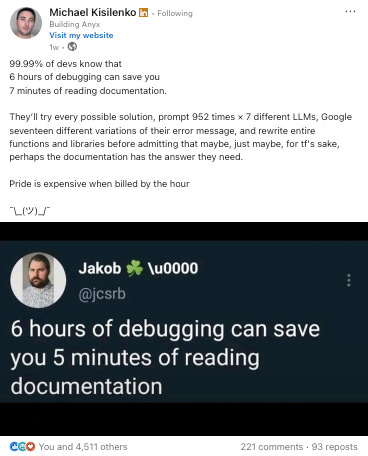
When Michael Kisilenko posted “6 hours of debugging can save you 7 minutes of reading documentation,” 4,500+ developers recognized themselves. Not because debugging is hard. Because they ALL skip the docs. They ALL know they shouldn’t. And they ALL do it anyway.
Battle Scars say: "I survived this." Self-Roasts say: "I still do this."
One earns sympathy. The other earns trust. Because admitting ongoing bad habits is riskier than resolved past pain—and your audience knows it.
That’s the Self-Roast: turning professional ego into tribal connection.
Here’s the framework.
🎁 Here’s What You’ll Get Today (free):
The 4 psychological triggers that make self-roasts irresistible (#4 is why posts get bookmarked)
The 5-part anatomy of the perfect Self-Roast post (each component with 'Why it works')
The 6-step process to mine your own roast-worthy behaviors (35 minutes, first draft to final)
4 advanced variations you can steal: The Tool Roast, The Seniority Roast, The Industry Roast, The Time Roast
The 5 classic mistakes that make self-roasts fall flat (#1 kills 90% of attempts)
💎 Paid Subscribers Also Get:
The copy-paste Self-Roast prompt that generates confession-based content in 2 minutes
🔪 The Brutal TL;DR:
The Mistake: Posting polished expertise that positions you above your audience
The Play: Roast yourself for behaviors your audience secretly does too—your worst habit is your best content
The Psychology: Self-deprecation signals authenticity; shared bad habits create tribal belonging
The Result: Comments filled with “I feel personally attacked” and mass colleague-tagging
🧠 The Psychology of the Self-Roast
Trigger 1: The Permission Slip Effect
(Why They Confess in Comments)
Nobody wants to admit they skip documentation. Or that they’ve mass-prompted 7 different LLMs before checking Stack Overflow. Or that they’ve rewritten entire functions rather than read a README.
But when someone ELSE admits it first—publicly, confidently, with specific details—they’ve issued a permission slip.
Suddenly, confession becomes safe. The comments flood with “I feel seen” and “why is this so accurate” because your audience has been carrying low-grade professional shame about these exact behaviors. Your post lets them exhale.
Trigger 2: The Tribal Recognition Signal
(Why They Tag Coworkers)
Battle Scars work because they say “you’re one of us if you’ve survived this.”
Self-Roasts say something even more powerful: “you’re one of us if you do this thing we all pretend we don’t do.”
One says 'we survived the same thing.' The other says 'we keep making the same mistake‘. Both create belonging. But admitting what you still do wrong bonds tighter than admitting what once went wrong.
The "99.99%" forces a choice: admit you do this, or lie. Nobody picks lie.
Trigger 3: The Ego Inversion
(Why Confession Beats Advice)
Most professional content follows a formula: establish expertise → deliver value → position yourself as authority.
The Self-Roast inverts this. You establish expertise BY admitting you don’t follow your own best practices. The confession IS the credibility.
Think about it: who’s more trustworthy?
The developer who writes “always read the docs before debugging”
The developer who admits they’ve spent 6 hours debugging to avoid 7 minutes of reading
The first one sounds like a conference talk. The second one sounds like someone who writes code.
LinkedIn is drowning in polished expertise. Ego inversion is a gasp of air.
Trigger 4: The Pride Tax Insight
(Why They Bookmark)
The best Self-Roasts don’t just confess—they name the cost.
Michael Kisilenko closes with: “Pride is expensive when billed by the hour.”
That line transforms a dev meme into genuine wisdom. It’s not just “we all do this dumb thing”—it’s “here’s what that dumb thing actually costs us.” The humor becomes insight. The confession becomes lesson.
This is what separates viral Self-Roasts from forgettable ones. The roast creates recognition. The Pride Tax creates saves.
The formula:
[Root cause] is expensive when [real stakes].“Perfectionism is expensive when shipped beats perfect.”
“Ego is expensive when your PR has been open for 3 weeks.”
“Overthinking is expensive when v1 just needs to work.”
The roast is shareable. The Pride Tax is quotable.
🧱 Anatomy of the Perfect Self-Roast Post
Let’s break down Michael Kisilenko’s post piece by piece.
Part 1: The Percentage Hook
99.99% of devs know that...Why it works:
Creates universal claim without hedging (”most devs” is weaker)
99.99% implies “basically everyone including you”
“know that” sets up an ironic truth (they know but don’t act on it)
Immediate tribal identification: if you’re a dev, this is about you
Part 2: The Inversion Statement
...6 hours of debugging can save you 7 minutes of reading documentation.Why it works:
Flips the advice everyone gives but nobody follows (documentation saves debugging time)
The ratio is the confession. Everyone’s done it, nobody’s calculated it.
It’s a complete thought—could stand alone as a tweet
Part 3: The Escalation Stack
They'll try every possible solution, prompt 952 times × 7 different LLMs,
Google seventeen different variations of their error message, and rewrite
entire functions and libraries...
Why it works:
One sentence. Four escalations. Each one more embarrassing than the last.
It reads like a rant. That’s why it sounds true. By the end, you’re laughing at yourself.
Part 4: The Reluctant Admission
...before admitting that maybe, just maybe, for tf's sake, perhaps the
documentation has the answer they need.
Why it works:
Triple hedging “maybe, just maybe, perhaps” mimics internal reluctant self-talk
The hedging language is intentional irony—we KNOW the docs have the answer
“for tf’s sake” lands because nobody swears in polished content. Frustration = real.
Part 5: The Pride Tax Close
Pride is expensive when billed by the hour ¯\_(ツ)_/¯Why it works:
“Pride” names the real cost. Not time, not productivity—ego. That’s the insight underneath the joke.
“billed by the hour” adds stakes. It’s not just funny, it’s expensive. That turns a meme into something you save.
The Secret Sauce: Confession Without Cringe
Notice what Michael does NOT do:
❌ No “I used to do this but I’ve grown” (humble brag)
❌ No “here’s how to fix this” (unsolicited advice)
❌ No “am I the only one?” (validation-seeking)
He states the behavior, escalates it, names the cost, shrugs. Done. The confidence of the confession is what makes it land. He’s not asking for absolution—he’s stating facts about the tribe.
